
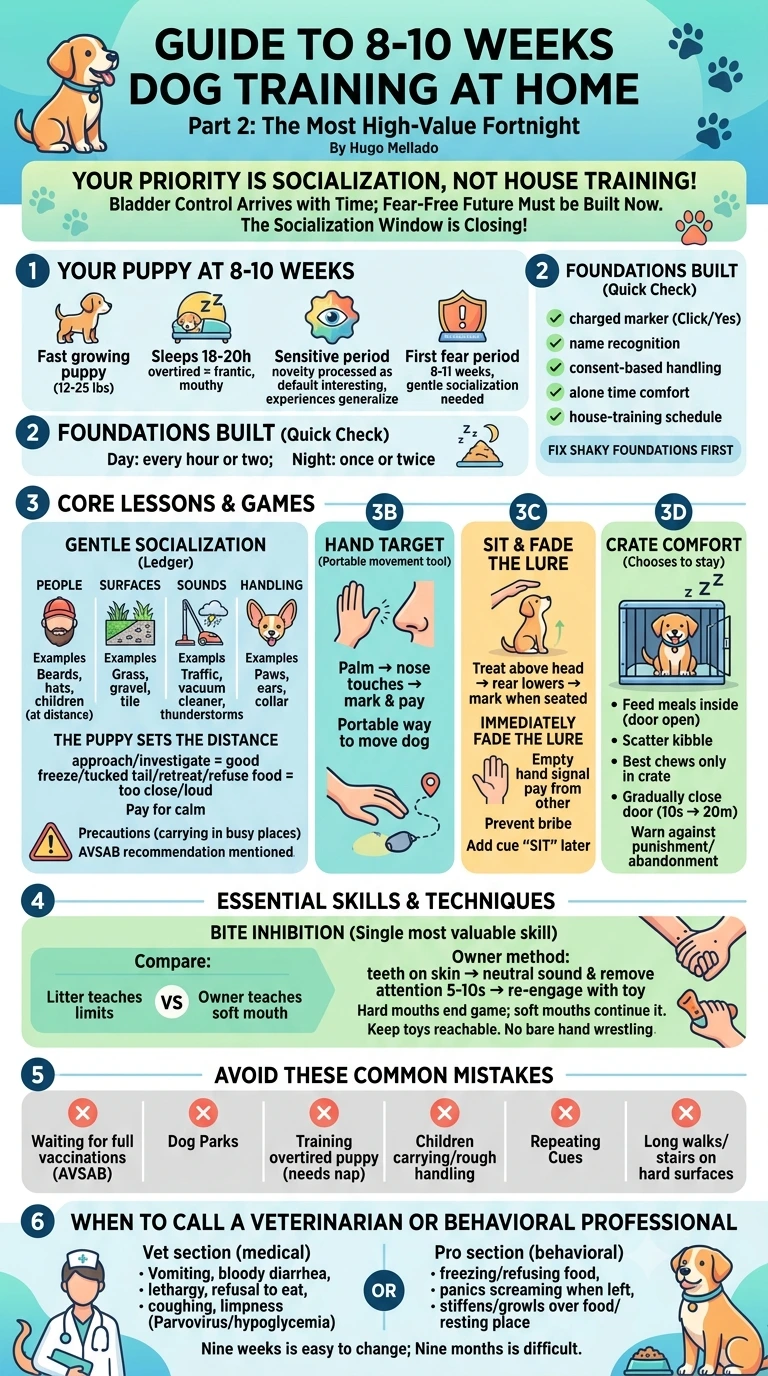
Puppy training 8 to 10 weeks starts the day the puppy comes home. The two weeks between eight and ten weeks old are the highest-value fortnight in a dog’s entire life, and most owners spend them worrying about house training. That is understandable, but it is the wrong priority. Bladder control arrives on its own with time; the ability to meet the world without fear does not, and the window in which it is easiest to build closes far sooner than people expect.
This part of the course covers what is actually happening in a medium or large breed puppy at this age, what the first lessons from Part 1 have already established, and the specific skills this fortnight can support: a real socialization plan, the first two cued behaviors, genuine comfort in a crate, and the beginning of a soft mouth. Everything is taught in sessions of one to three minutes, because that is the honest attention span you are working with.
Puppy training 8 to 10 weeks: where your puppy is now
Physically, a large breed puppy at this age weighs somewhere between twelve and twenty-five pounds and is growing fast enough that food intake and joint protection both matter. It sleeps between eighteen and twenty hours a day, in short blocks, and an overtired puppy behaves almost exactly like a badly behaved one: frantic, mouthy and unable to settle. Bladder capacity is roughly one hour per month of age plus one, so expect to be outside every hour or two during the day and once or twice overnight.
Cognitively, this is the tail end of the sensitive period for socialization, which runs from around three weeks to twelve or fourteen weeks. During it, novelty is processed as interesting by default and experiences generalize easily. After it closes, novelty is processed as potentially dangerous by default, and the same exposure that would have taken five minutes at nine weeks can take months of careful counter-conditioning at nine months. This is why the American Veterinary Society of Animal Behavior recommends starting socialization before the vaccination series is complete, using sensible precautions rather than waiting.
Socially, the puppy has just lost its litter, which was its entire source of feedback about bite pressure, play rules and comfort. It is also entering a first fear period, roughly between eight and eleven weeks, in which a single frightening event can leave a lasting impression. That combination is the argument for a socialization plan that is deliberately gentle: quantity of pleasant, low-intensity exposure, not intensity.
What you have already built
From Part 1 the puppy should already have a charged marker, so that the click or the word yes reliably predicts food; a name that has only ever meant good things and produces a head turn; the beginning of consent-based handling, with ears, paws and collar touched briefly and paid; a first experience of being alone with something good to chew; and a house-training schedule that belongs to you rather than to the puppy. If any of those are shaky, spend three more days on them before adding anything. They are the vocabulary the rest of the course is written in.
What you are teaching now
Four things, in order of importance. A socialization plan that covers people, surfaces, sounds and handling without ever frightening the puppy. Two cued behaviors, a hand target and a sit, taught by luring and immediately faded. Real comfort in the crate, meaning the puppy chooses to go in. And the first work on bite inhibition, which is the single most valuable behavior a future eighty-pound dog can learn while its jaws are still harmless.
Techniques and games
The socialization ledger
Keep an actual list on the refrigerator with four columns: people, surfaces, sounds, and handling. Aim for two or three new pleasant experiences a day, each one paired with food. People means beards, hats, uniforms, wheelchairs, children at a distance, people of different sizes and skin tones, all approaching calmly and ideally tossing a treat rather than reaching over the head. Surfaces means grass, gravel, tile, metal grates, wobbly cushions, wet pavement, stairs with supervision. Sounds means traffic, vacuum cleaner, doorbell, thunderstorm recordings played quietly, all at a volume where the puppy notices and then goes back to what it was doing. Until vaccinations are complete, carry the puppy in busy places, use a blanket in the trunk of the car as a viewing platform, and choose clean private yards over dog parks.
The rule that makes socialization safe is simple: the puppy sets the distance. If it approaches, investigates and returns to you, the exposure worked. If it freezes, tucks its tail, tries to retreat or refuses food it normally loves, you are too close or too loud. Increase distance, pay for calm observation, and try again another day at a lower intensity. Forcing a frightened puppy to greet somebody is how you manufacture an adult that lunges at strangers.
Hand target
Hold a flat palm an inch or two from the puppy’s nose. Curiosity does the rest: the instant the nose touches your palm, mark and pay from the other hand. Repeat five times, then move your palm slightly to one side so the puppy has to take a step. Five repetitions, three times a day, and within a week you have a portable, cheerful way to move your dog without touching the collar, which will later become the backbone of recall, of polite greetings and of getting a two-hundred-pound-per-square-inch mouth away from something it should not have.
Sit, and how to fade the lure
Hold a treat at nose level, move it slowly back over the head, and the rear end lowers as the head lifts. Mark the moment the rear touches the floor and pay. After five successful repetitions, do the identical hand movement with an empty hand and pay from the other hand. This matters more than it sounds: a lure that is never faded becomes a bribe the dog waits to see, and that is the origin of every dog that only obeys when food is visible. Add the word sit only once the puppy is offering the behavior fluently, saying it just before the hand signal.
Making the crate the best room in the house
Feed every meal inside the crate with the door open. Scatter a few pieces of kibble in there at random moments so the puppy discovers that checking the crate pays. Give the good chew, the stuffed food toy and the lickable mat only inside it. Then start closing the door for ten seconds while the puppy is busy, opening it before it finishes, and build gradually to twenty minutes while you stay in the room. A crate that has been used as a punishment or as a place where the puppy is abandoned in distress stops working, and a large adult dog that hates confinement is a serious problem at the veterinary clinic, in the car and after any surgery.
The beginning of a soft mouth
Puppies bite. It is not aggression and it is not dominance; it is how they explore and how they play, and a litter would have taught the limits by yelping and disengaging. Your version: when teeth touch skin with any real pressure, make a short neutral sound, remove your hands and your attention for five to ten seconds, then re-engage with a toy in your hand. What the puppy learns is that hard mouths end the game and soft mouths continue it. Keep a toy within reach at all times so there is always a legal target, avoid wrestling with bare hands, and never hold the muzzle shut, flick the nose or pin the puppy, all of which raise arousal and damage trust.
Common mistakes in this fortnight
- Waiting until the vaccination series is finished to socialize, which trades a small and manageable infectious risk for a large behavioral one.
- Taking a nine-week-old puppy to a dog park, where uncontrolled adult dogs can undo weeks of careful work in ten seconds.
- Training when the puppy is overtired; if it becomes frantic and mouthy, the answer is usually a nap, not more exercise.
- Letting children carry, chase or wake the puppy, which teaches it that human hands are unpredictable.
- Repeating cues. Say a word once; if the behavior does not happen, the criteria were too hard, not the puppy too stubborn.
- Long walks on hard surfaces or stairs, which large breed joints do not need at this age; short exploration is enough.
When to call a professional or a veterinarian
This is the age of the first vaccination visits, so use them. Call sooner for vomiting, diarrhea, especially if bloody, lethargy, refusal to eat, coughing or a puppy that feels limp, since parvovirus and hypoglycemia both move quickly in unvaccinated puppies. On the behavior side, ask for help early if the puppy freezes and will not take food in ordinary environments, screams in panic when left for even a minute, or stiffens and growls over food or a resting place. At nine weeks these patterns are usually easy to change; at nine months they are not.
Previous: Part 1: Foundations, Methods and the First Lessons · Next: Part 3: Ten to Twelve Weeks · Course index: All ten parts
Keep reading: Dog Care Guide · Adopt, Don’t Shop · Choosing Your First Pet
Further reading (external): Animal Legal & Historical Center — Table of State Laws Concerning Minimum Age for Sale of Puppies — the state-by-state rules in the United States on how old a puppy must be before it can legally be sold or rehomed.
This course is educational and does not replace individual professional advice. Follow your own veterinarian’s guidance on vaccination and on where it is safe for your puppy to walk in your area.