Puppy training 10 to 12 weeks builds directly on the fortnight before it. Between ten and twelve weeks a puppy stops being a passenger and starts being a participant. It follows you around the house, watches what you do, and begins to make its own decisions about what is worth investigating. The first fear period is ending, coordination is improving, and the sensitive socialization window has perhaps two or three weeks left. This is the fortnight in which the two behaviors that will matter most for the next fifteen years, coming when called and giving things up willingly, are cheapest to install.
It is also the fortnight in which most owners of large breed puppies make their first genuinely expensive mistake, usually by taking a toy out of a puppy’s mouth with their hands, or by calling the puppy to end something enjoyable. Both are understandable and both are avoidable, and this part explains what to do instead.
Puppy training 10 to 12 weeks: where your puppy is now
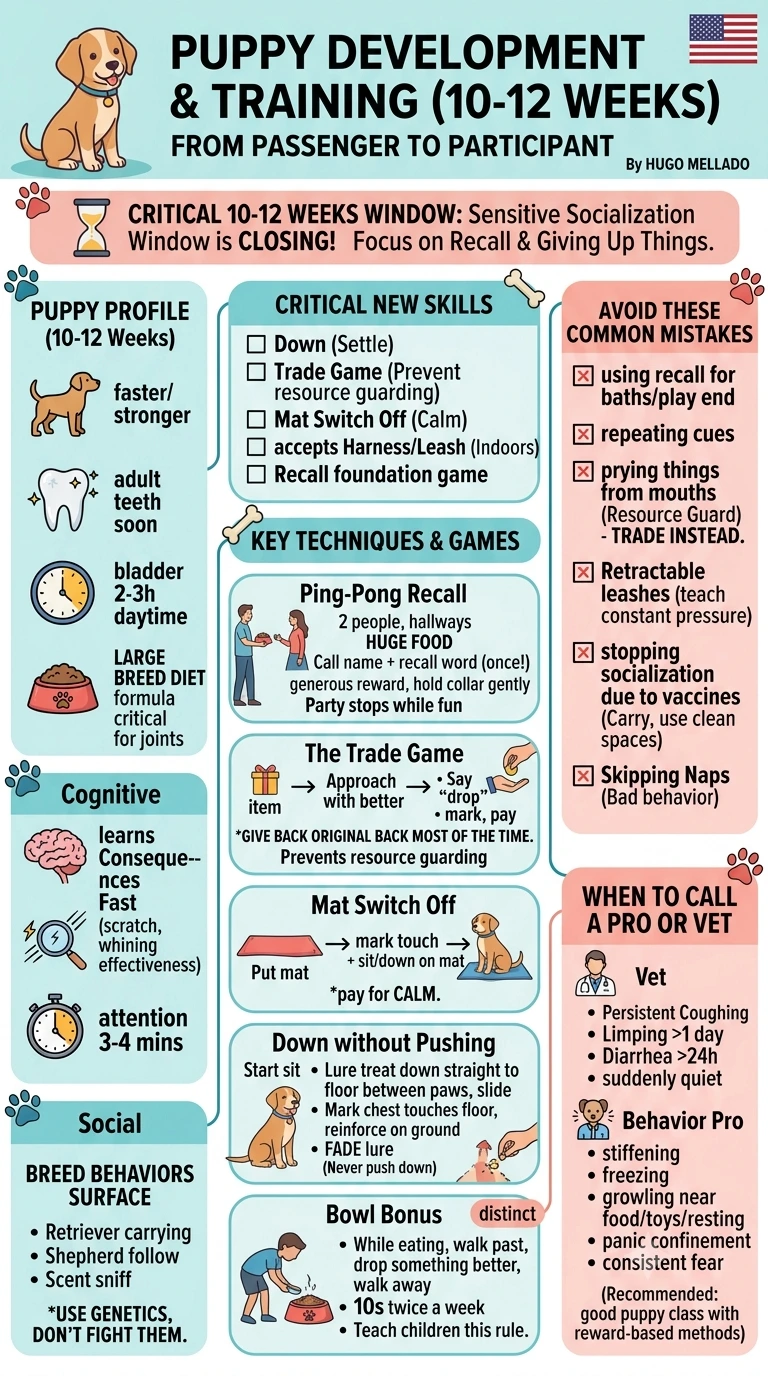
Physically the puppy is stronger and considerably faster, with better balance and the first adult teeth still a few weeks away. Bladder capacity has grown to roughly two or three hours in the daytime, and most puppies now sleep through a good part of the night. Growth in a large breed is rapid enough that food should be a diet formulated for large breed puppies, since calcium and calorie excess in this window is associated with developmental joint problems later.
Cognitively the puppy is now learning consequences fast, and the learning is no longer confined to what you deliberately teach. It is discovering which surfaces sound interesting when scratched, which humans drop food, and how effective a particular whine is. Attention spans have stretched to perhaps three or four minutes for something enjoyable, which allows slightly longer training sessions with more repetitions in each.
Socially, breed-typical behaviors start to surface. Retriever puppies pick things up and carry them around, shepherd puppies begin following movement and circling, scent breeds put their nose down and stop hearing you. None of this is a problem yet; all of it is information about what your dog will find reinforcing, and a training plan that uses the dog’s own genetics is far easier than one that fights them.
What you have already built
By now the marker means food is coming, the name produces a head turn, a hand target moves the puppy without touching it, sit is offered fluently with a faded lure, and the crate is a place the puppy chooses. The socialization ledger has been running for a fortnight, handling is paired with food, and house training is on a schedule that produces mostly clean days. Bite inhibition work has begun, so hard mouths end games and soft mouths continue them. If the ledger is the thing that has slipped, prioritize it this fortnight, because the window will not reopen.
What you are teaching now
Five additions. A down, which is the beginning of every future settle. A recall foundation built as a game rather than a command. Acceptance of a harness and leash indoors before they are ever used to control anything. A trade, which prevents resource guarding before it exists. And a mat that means switch off, which is the most useful single behavior a large dog can own in a family home.
Techniques and games
Down without pushing
From a sit, hold a treat at the puppy’s chest and lower it straight down to the floor between the front paws, then slide it a fraction toward you. Elbows follow the food down. Mark the instant the chest touches the floor and pay on the ground, which reinforces staying down rather than popping up. Fade the food from the hand after five repetitions, add the word only when the movement is reliable, and never push a puppy’s shoulders down: it teaches resistance to pressure, which is precisely the wrong lesson to give a dog that will weigh eighty pounds.
Ping-pong recall
Two people, a hallway, and a handful of excellent food. One person says the puppy’s name and the recall word once, in a bright tone, and the other lets the puppy go. When it arrives, mark, pay generously with several pieces one after another, and hold the collar gently for a second while paying, so that being caught also predicts good things. Then the other person calls. Six repetitions and stop while it is still a party. The rules that keep recall alive for the next decade start here: call once, pay disproportionately, never call the puppy for anything it dislikes, and never call when you are fairly sure it will not come.
The trade game
Give the puppy a moderately interesting item, then approach with something better, say the word drop, and offer the trade. The item is released, you mark, you pay, and then, crucially, you give the original item back most of the time. A dog that learns that human hands near its possessions predict an upgrade never develops a guarding problem. A dog that learns that hands take things away learns to swallow fast, run away or freeze, and that is the dog that bites a child over a chicken bone at eighteen months. Never chase a puppy that has stolen something, never pry a mouth open, and keep a jar of good trades in the kitchen.
Bowl bonus
While the puppy eats, walk past and drop something better than the food into the bowl, then walk away. Ten seconds of work, twice a week, and food bowls stay uncomplicated forever. Do not take the bowl away to prove a point, and do not put hands in the bowl while the puppy is eating. Teach children the same rule: eating dogs are left alone, and the game is played by adults.
Harness, leash and the art of doing nothing
Introduce the harness in the house with no walk attached. Show it, pay, put it on for ten seconds, pay, take it off. Build to a few minutes while the puppy plays. Then clip on a light leash and let it drag under supervision for short periods, so that pressure is something the puppy discovers on its own terms rather than something you apply. Only then pick up the leash and follow the puppy around the room, paying whenever it happens to move toward you. A puppy that has never had its neck jerked before its first walk starts leash training with no baggage at all.
The mat that means switch off
Put a small mat on the floor. Every time the puppy touches it, mark and pay on the mat. Then wait for a sit on the mat, then a down, then simply pay every few seconds while it stays down. Feed the calm, not the arrival. Within a couple of weeks you will be able to send a large puppy to a mat while you eat dinner or answer the door, and that behavior will still be doing useful work when the dog is ten years old.
Common mistakes in this fortnight
- Using the recall word for baths, nail trims or the end of playtime; go and get the dog for those instead.
- Repeating a cue several times, which teaches the puppy that the first three are optional.
- Removing stolen objects by force rather than trading, the single most common origin of guarding in large breeds.
- Starting walks on a retractable leash, which teaches constant pressure and is genuinely dangerous with a strong dog.
- Ending socialization because the vaccination series is not finished; carry the puppy, use clean spaces, keep going.
- Skipping naps; a puppy this age still needs eighteen hours of sleep and behaves badly without them.
When to call a professional or a veterinarian
Keep the vaccination and deworming schedule, and use the visit to ask about large breed growth and diet. Call sooner for persistent coughing, limping that lasts more than a day, diarrhea beyond twenty-four hours, or any puppy that becomes suddenly quiet. On the behavior side, get help now rather than later if the puppy stiffens, freezes or growls when approached near food, toys or a resting place, if it panics when confined, or if it is consistently frightened of ordinary household events. A good puppy class, run with reward-based methods and requiring proof of age-appropriate vaccination, is worth the money at this age for the controlled exposure alone.
Previous: Part 2: Eight to Ten Weeks · Next: Part 4: Three to Four Months · Course index: All ten parts
Keep reading: Dog Care Guide · What Children Learn from Growing Up with a Pet · How to Ask Your Parents for a Dog
Further reading (external): AVSAB — Position Statements — the American Veterinary Society of Animal Behavior on puppy socialization and humane, reward-based training.
This course is educational and does not replace individual professional advice. Growling is information, not defiance; if you see it around food or possessions, contact a qualified reward-based trainer or a veterinary behaviorist rather than punishing it.