
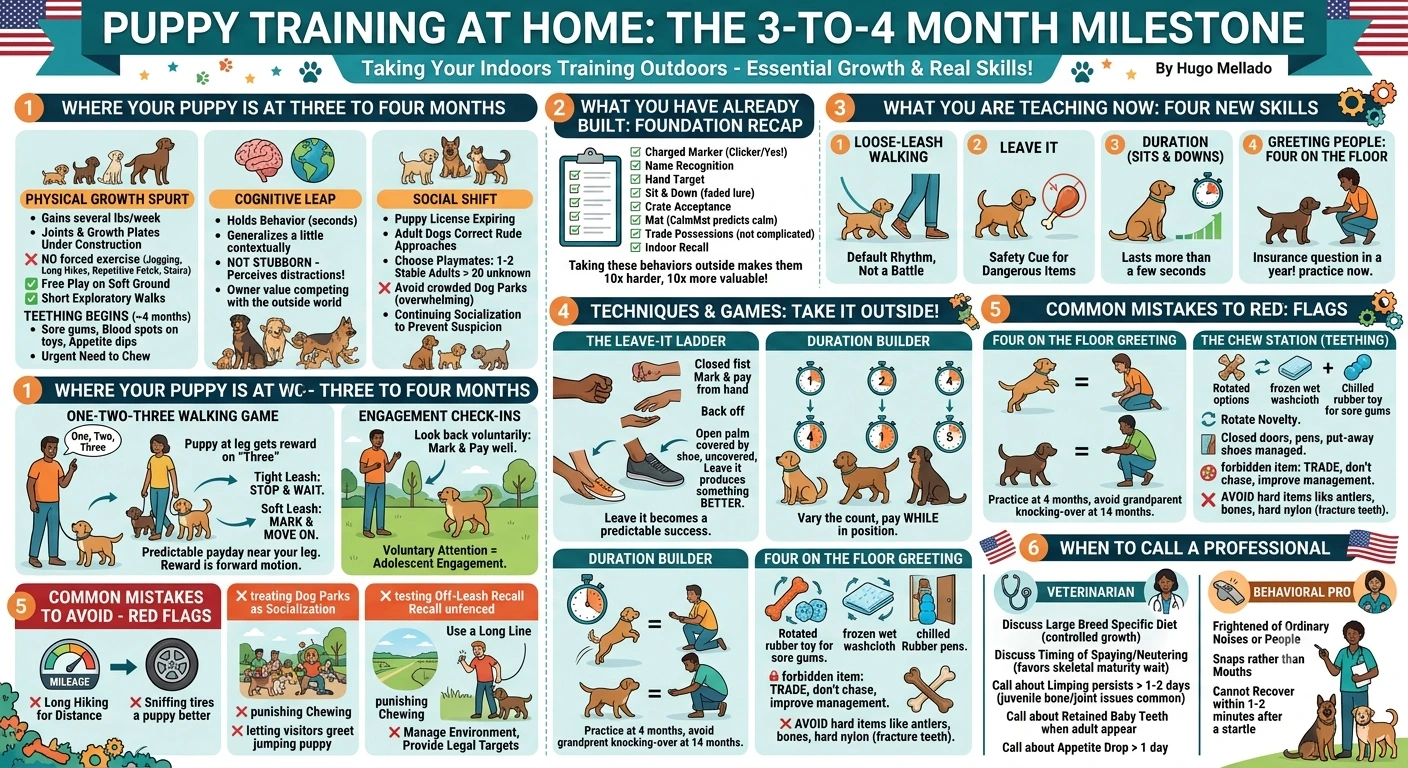
Puppy training 3 to 4 months is the stage where the outside world arrives. Three months is where training stops being theoretical. The vaccination series is finishing, the world opens up, and a puppy that has been a delightful houseguest suddenly discovers that outside is more interesting than you are. At the same time the adult teeth start pushing through, which turns a mild chewer into a determined one. This part of the course is about keeping the relationship you built indoors when you take it outdoors.
The sensitive socialization window is now closing, but the work does not stop; it changes shape. What was exposure becomes maintenance, and what was curiosity becomes preference. A medium or large breed puppy that meets no new people during month four will not simply stay neutral about strangers. It will slowly become suspicious of them.
Puppy training 3 to 4 months: where your puppy is now
Physically this is a growth spurt. A large breed puppy may gain several pounds a week, and joints, tendons and growth plates are all under construction, which is why forced exercise is limited at this age: free play on soft ground and short exploratory walks rather than jogging, long hikes, repetitive fetch on hard surfaces or stairs. Teething begins around four months, with incisors first and then premolars, and it produces sore gums, blood spots on toys, occasional appetite dips and an urgent need to chew something.
Cognitively the puppy can now hold a behavior for a few seconds, generalize a little between contexts, and above all notice distractions. This is the age at which owners conclude that their puppy has become stubborn. It has not. It has simply become able to perceive the rest of the world, and the value of your food has to compete with it for the first time.
Socially, the puppy license that adult dogs extend to very young puppies begins to expire. Adults that tolerated everything at ten weeks start correcting rude approaches, which is normal and useful when it comes from a stable adult dog, and damaging when it comes from an overwhelmed dog in a crowded dog park. Choose playmates deliberately: one or two known, appropriate adult dogs are worth more than twenty unknown ones.
What you have already built
The puppy has a charged marker, a name, a hand target, sit and down with faded lures, a crate it likes, a mat that predicts calm, a trade that keeps possessions uncomplicated, and a recall that works enthusiastically indoors. Handling is paired with food, the leash has never been used to jerk anything, and house training is mostly reliable with an occasional accident when the schedule slips. Everything this part adds is a way of taking those behaviors outside, where they are worth ten times as much and are ten times harder.
What you are teaching now
Four skills. Loose-leash walking as a default rather than a battle. Leave it, which is the safety cue that will one day stop your dog eating something dangerous on a sidewalk. Duration, so that a sit or a down lasts more than a second. And greeting people with four feet on the floor, which is a training exercise now and an insurance question in a year.
Techniques and games
The one-two-three walking game
Walking on a loose leash is a rhythm, not a position. Count out loud, one, two, three, and deliver a piece of food beside your leg on three, then start counting again. The puppy learns that staying near your leg produces a predictable payday, and the counting gives you something to do besides pulling. Start in the hallway, then the driveway, then the quiet end of the street. When the leash goes tight, stop walking and wait; the instant it softens, mark and move on. Forward motion is the reward, and tension is what removes it.
Check-ins that build engagement
Stand still in a mildly interesting place and say nothing at all. The moment the puppy looks back at you of its own accord, mark and pay well. That is the whole exercise. Voluntary attention is far more durable than attention you demand, and a puppy paid for checking in twenty times on a walk becomes an adolescent that still remembers you exist at eight months, which is when you will need it.
The leave-it ladder
Put a boring treat in a closed fist. The puppy will lick, nudge and paw; ignore all of it. The instant it backs off, mark and pay from the other hand, never from the fist. Progress to an open palm that closes if the puppy dives, then to food on the floor covered by your shoe, then uncovered, then dropped as you walk past. Add the words leave it once the puppy is turning away reliably. The rule that makes this work is that leaving the item always produces something better, so the cue never becomes a disappointment.
Building duration honestly
Ask for a sit, count one second, mark and pay. Then two seconds, then four, then back to one, then five. Vary the number rather than climbing steadily, and pay while the puppy is still in position rather than after it gets up. Add distance separately from duration, and distraction separately from both: a puppy that can hold a down for thirty seconds in the kitchen cannot hold it for three seconds at the park, and that is not disobedience but a different exercise.
Four on the floor
Jumping is not naughtiness, it is a greeting that works. It stops working when it never earns attention and something else does. Set up the situation deliberately with a helper: the helper approaches, and if the puppy’s feet leave the ground, the helper turns and walks away without a word. If the puppy keeps four feet down, the helper crouches sideways and pays at chest height, low enough that the puppy has no reason to lift. Practicing this at four months, when a jump is charming, is the only way to avoid a ninety-pound dog knocking over a grandparent at fourteen months.
Teething and the chew station
A teething puppy will chew; the only decision is what. Rotate three or four appropriate options so novelty does not run out, keep a frozen wet washcloth or a chilled rubber toy for sore gums, and manage the rest of the house with pens, closed doors and put-away shoes. Avoid anything harder than a fingernail can dent, since antlers, bones and hard nylon fracture the large carnassial teeth that are about to arrive. If the puppy grabs something forbidden, trade rather than chase, then quietly improve your management so it does not happen again.
Common mistakes in this stage
- Walking a large breed puppy for distance rather than for exploration; sniffing tires a puppy far more usefully than mileage does.
- Treating the dog park as socialization, when it is usually the opposite at this age.
- Testing off-leash recall in an unfenced area; use a long line for the next several months.
- Punishing chewing instead of managing the environment and providing legal targets.
- Letting visitors greet a jumping puppy because they say they do not mind.
- Repeating cues in distracting places rather than lowering the difficulty until success returns.
When to call a professional or a veterinarian
This is the visit at which to discuss two large breed specifics: the diet that supports controlled growth, and the timing of spaying or neutering, since current evidence in several large breeds favors waiting until skeletal maturity rather than operating early. Call about limping that persists beyond a day or two, since juvenile bone and joint conditions are more common in these breeds, about retained baby teeth once the adult ones appear, and about any drop in appetite that lasts more than a day. On the behavior side, seek help if the puppy is frightened of ordinary noises or people, snaps rather than mouths, or cannot recover after a startle within a minute or two.
Previous: Part 3: Ten to Twelve Weeks · Next: Part 5: Four to Six Months · Course index: All ten parts
Keep reading: Dog Care Guide · The Daily Dog Walk · New Feeding Trends for Dogs and Cats
Further reading (external): Petfinder — Dogs and puppies for adoption — adoptable dogs listed by a network of more than 14,000 shelters and rescue groups across the United States.
This course is educational and does not replace individual professional advice. Exercise limits, diet and the timing of neutering in large breeds should be decided with your own veterinarian, who can assess your individual dog.