

Nobody overfeeds a dog out of neglect. It happens through love: one extra treat because those eyes are hard to refuse, a bowl topped up "just a little," the last bite of a sandwich passed under the table. Surveys by the Association for Pet Obesity Prevention consistently find that more than half of dogs in the United States are overweight or obese — and most owners of overweight dogs describe them as "normal," because a slightly round dog has quietly become the new normal.
Here is the encouraging part: an overweight dog is one of the few serious health problems you can genuinely fix at home, without medication, using things you already control — the bowl, the treat jar, the leash and your daily routine. This guide walks through how to tell whether your dog is carrying extra pounds, and then how to take them off safely: what to feed, how to change the habits around food, and how to rebuild exercise both out on the street and inside the house.
How to tell if your dog is overweight
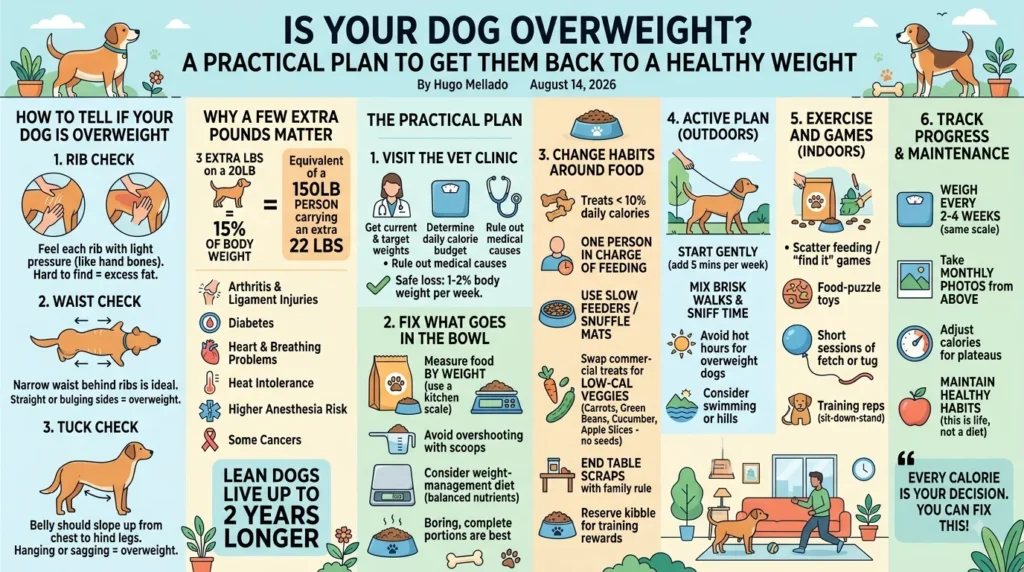
Veterinarians score dogs on a nine-point body condition scale, where 4–5 is ideal. You do not need the chart to do a first check at home — you need your hands and two honest looks:
- The rib check. With light pressure, you should be able to feel each rib under a thin layer of padding — about like feeling the bones on the back of your hand. If you have to press to find ribs, there is too much fat over them.
- The waist check. Seen from above, your dog should narrow visibly behind the ribs. A straight or bulging line from chest to hips means excess weight.
- The tuck check. Seen from the side, the belly should slope up from the chest toward the hind legs, not hang level or sag.
If your dog fails two of the three, assume there is weight to lose. The American Veterinary Medical Association’s healthy weight guide has good visual references, and any veterinary clinic will weigh your dog for free if you ask.
Why a few extra pounds matter more than you think
On a 20-pound dog, three extra pounds is not a cosmetic issue — it is 15 percent of their body weight, the equivalent of a 150-pound person carrying an extra 22. Excess weight in dogs is strongly linked to arthritis and cruciate ligament injuries, diabetes, heart and breathing problems, heat intolerance, higher anesthesia risk and some cancers. The Cornell University College of Veterinary Medicine calls obesity the biggest health problem in canine medicine, and a landmark lifetime study of Labradors found that dogs kept lean lived up to two years longer than their overfed littermates.
Two years. No supplement, no premium food and no medication on the market offers anything close to that. Keeping your dog at a healthy weight is the single most powerful thing you can do for their lifespan.
Start at the veterinary clinic, not the pantry
Before changing anything, book a weigh-in. A vet will rule out the few medical causes of weight gain that diet cannot fix — hypothyroidism and Cushing’s disease are the classic two — and will give you three numbers that turn a vague worry into a plan: your dog’s current weight, a realistic target weight, and a daily calorie budget to get there. Safe weight loss for dogs is gradual, around 1–2 percent of body weight per week; faster than that risks muscle loss and nutritional gaps.
If you like reading the source material, university veterinary programs publish excellent owner-level guidance — Cornell’s Riney Canine Health Center shares practical weight management tips, and the clinical nutrition team at Tufts’ Cummings School of Veterinary Medicine runs Petfoodology, one of the most trustworthy pet nutrition sites on the internet.
Fix what goes in the bowl
Almost every canine weight-loss plan succeeds or fails on one unglamorous habit: measuring food by weight. Scoops, mugs and eyeballing routinely overshoot by 20–50 percent, and the feeding chart printed on the bag describes an active adult dog, not a neutered couch companion — most pets need less than the label suggests. A $15 kitchen gram scale removes all the guesswork.
What you feed matters too. Simply halving your dog’s regular kibble also halves their vitamins, minerals and protein, which is why vets often recommend a dedicated weight-management or prescription weight-loss diet for dogs with a lot to lose: these are formulated to cut calories while keeping nutrients and protein high, so the dog loses fat rather than muscle and feels fuller. We looked at what the evidence says about raw, grain-free and other fashionable diets in New Feeding Trends for Dogs and Cats — the short version applies here as well: boring, complete and correctly portioned beats trendy every time.
Change the habits around the food
Most extra calories do not come from the bowl. They come from everything orbiting it: training treats, chews, dental sticks, the toddler’s dropped dinner, the grandparent who "only gives him a little something." Treats should stay under 10 percent of daily calories — and they count against the budget, not on top of it.
- Put one person in charge of feeding, or keep a simple checklist on the fridge so the dog cannot collect two dinners by looking hungry at the right people.
- Swap treats for vegetables. Most dogs happily accept baby carrots, green beans, cucumber or apple slices (no seeds) — single-digit calories instead of 30–70 per commercial treat.
- End table scraps with a family rule, not individual willpower. The dog stops begging within a couple of weeks once it never works.
- Feed scheduled meals, not a free-fed bowl, and use a slow feeder or snuffle mat so a meal takes ten minutes instead of forty seconds.
- Reserve part of the daily kibble ration as "treats" for training and games, so rewards cost nothing extra.
Walks: the cheapest weight-loss tool you own
For an overweight dog, exercise starts gently. Begin with the walks your dog can already do comfortably and add five minutes per walk each week, rather than launching into an hour-long march that leaves sore joints and a discouraged dog. Two or three moderate walks a day beat one exhausting one, and on hot days walk early and late — overweight dogs overheat much faster than lean ones.
Mix two kinds of walking: brisk, purposeful stretches where the leash is short and you keep a pace, and free sniffing time, which burns less fat but works the brain and keeps the walk rewarding for the dog. As the weight comes down, add hills, longer weekend routes or swimming, which is ideal low-impact exercise for dogs with sore joints. We wrote about how this one habit reshapes the whole household — not just the dog — in The Daily Walk.
Exercise and games inside the house
Bad weather is not a rest day. A surprising amount of movement fits inside an apartment:
- Scatter feeding and "find it" games: toss part of the meal ration across the kitchen floor or hide small piles around the house and let your dog hunt them out.
- Food-puzzle toys turn dinner into twenty minutes of pushing, rolling and problem-solving.
- Hallway fetch and tug in short, frequent sessions — five minutes, three times a day, adds up.
- Training reps are exercise: a round of sit–down–stand repetitions is the canine version of squats, and a tired brain calms a food-focused dog. Our step-by-step course Dog Training at Home is full of games that double as workouts.
Track progress and keep the weight off
Weigh your dog every two to four weeks on the same scale — walk-on scales at the vet are free to use — and take a photo from above once a month, because a waist reappears before the number moves much. Expect a plateau or two; they break with a small calorie adjustment, not with skipped meals. When your dog reaches target weight, increase food gradually to a maintenance amount while you keep weighing monthly. The measuring, the treat budget and the daily exercise are not a temporary diet: they are simply how your dog eats and lives now, and they are why the weight stays off.
Your dog cannot open the refrigerator, fill the bowl or hand out treats. Every calorie is a decision someone in the house makes — which sounds like blame but is actually the good news, because it means every one of those decisions is yours to change, starting with the next meal.
Keep reading: Dog care guide · The Daily Walk · New feeding trends for dogs and cats · Dog Training at Home, Part 1
Pet & Pet publishes educational content written and reviewed by Hugo Mellado. It is not veterinary advice and never replaces an examination by a licensed veterinarian. If an animal is unwell, contact a veterinary professional. Read our full Disclaimer.
Leave a Reply