
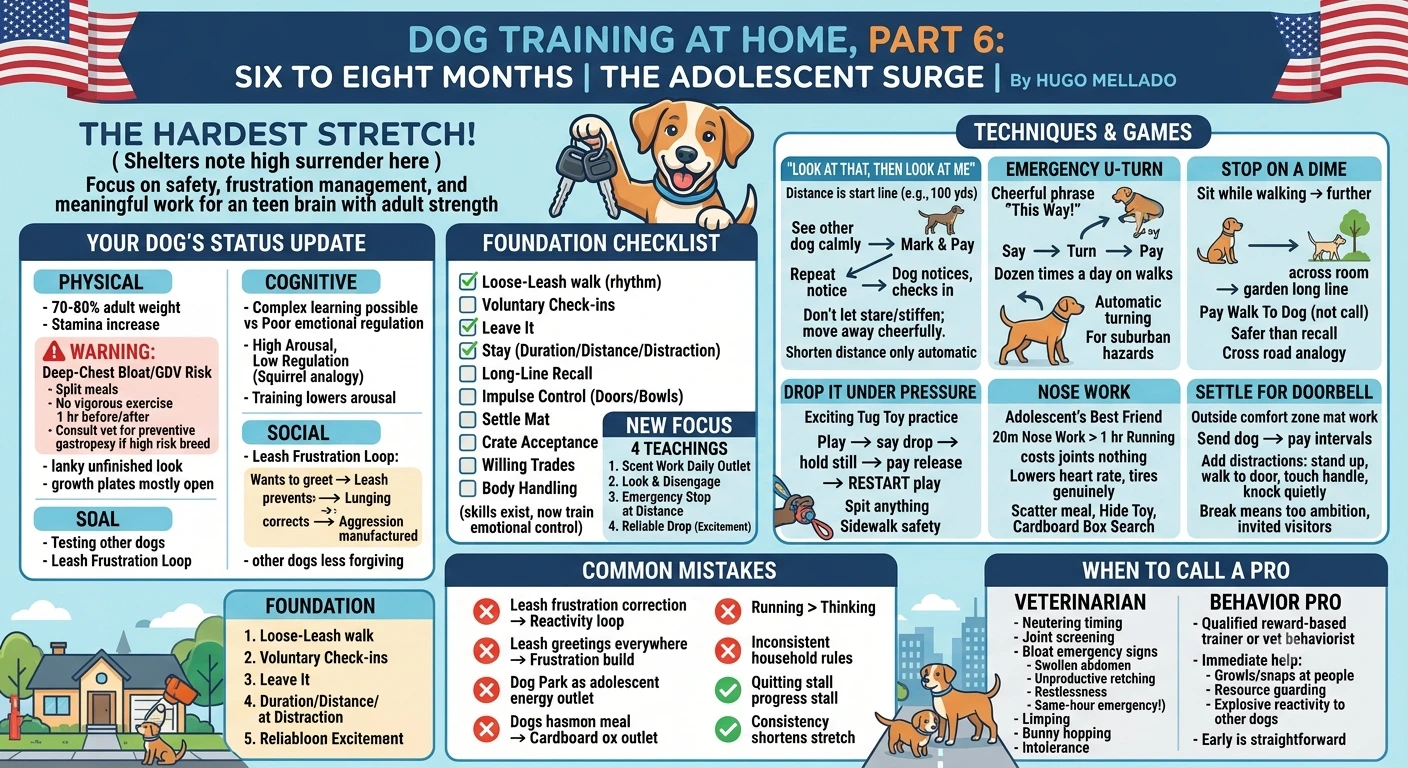
Dog training 6 to 8 months deserves a warning up front. Six to eight months is the hardest stretch of the whole eighteen, and it is worth saying so plainly. This is the age at which American shelters receive the largest share of surrendered adolescent dogs, almost always for the same three reasons: pulling that has become unmanageable, barking and lunging at other dogs on leash, and a recall that has quietly stopped existing. None of the three are character flaws. All three are predictable at this age, and all three respond to a specific plan.
Your dog is now close to adult height, has adult strength and an adolescent brain. It is the canine equivalent of handing a fifteen-year-old the keys to a truck. The training goal for these two months is not new obedience; it is keeping the dog safe, keeping frustration from turning into reactivity, and giving a large, energetic animal enough legitimate work that it stops inventing its own.
Dog training 6 to 8 months: where your dog is now
Physically a medium or large breed is now at perhaps seventy or eighty percent of adult weight and close to full height, with a lanky, unfinished look. Growth plates are still open in the largest breeds, so impact loading remains limited, but stamina has increased sharply and the dog needs real activity. In deep-chested breeds this is also the age to start the feeding habits that reduce the risk of gastric dilatation and volvulus: meals split into two or three, no vigorous exercise for an hour before and after eating, and a conversation with your veterinarian about preventive gastropexy if your breed is high risk.
Cognitively the dog can learn complex chains and hold long behaviors, but emotional regulation lags well behind. Arousal rises faster and falls more slowly than it did two months ago, which is why a dog can be perfectly polite at the start of a walk and impossible after seeing a squirrel. Training that lowers arousal is now as valuable as training that adds behaviors.
Socially the dog is testing, and other dogs are less forgiving. Leash frustration commonly appears here: a friendly adolescent that wants to greet every dog it sees, is repeatedly prevented by a leash, and converts that frustration into barking and lunging. Owners often read this as aggression and respond with corrections, which pairs the sight of other dogs with something unpleasant and manufactures the aggression that was not there.
What you have already built
Loose-leash walking with a rhythm, voluntary check-ins, leave it, a stay taken apart into duration, distance and distraction, a long-line recall, impulse control at doors and bowls, a settle mat, a crate the dog likes, willing trades and a body that accepts handling. The behaviors exist. What this stage adds is the emotional skill to use them when the dog is excited, which is a different thing entirely and has to be trained on purpose.
What you are teaching now
Four things. A structured way to look at other dogs and disengage. An emergency stop that works at distance. A reliable release of anything in the mouth, including under arousal. And scent work as a daily outlet, because for a large adolescent, twenty minutes of nose work is worth more than an hour of running and costs the joints nothing.
Techniques and games
Look at that, then look at me
Find a distance at which your dog can see another dog and still eat. That distance is your starting line, and it may be a hundred yards at first. Each time your dog looks at the other dog calmly, mark and pay. After a few repetitions most dogs start looking at the other dog and then turning to you for payment, which is exactly the behavior you want: notice, then check in. Shorten the distance only when the pattern is automatic. Never let the dog stare, stiffen and build; that is the moment to move away cheerfully, not to correct.
The emergency U-turn
Teach a cheerful phrase, this way, that means we are going in the opposite direction right now. Practice it with no trigger at all: say it, turn, jog three steps, pay. Do it a dozen times a day on ordinary walks until the dog turns automatically. Then it is available when a loose dog appears around a corner, when a child runs at you, or when your dog spots something you would rather it did not investigate. This is the single most useful skill for walking a large adolescent in a suburban American neighborhood.
Stop on a dime
Ask for a sit while the dog is walking toward you, then a few feet further away, then across a room, then in the garden on a long line. Pay by walking to the dog rather than calling it. An emergency stop is often safer than a recall, because a dog that stops where it is does not cross the road it is standing beside. Build it slowly and never use it as a punishment for having gone somewhere.
Drop it under pressure
Your trade game now needs to work when the item is exciting. Practice with a tug toy: play, say drop, hold still, and pay when the toy is released, then immediately restart the game so the release predicts more fun rather than the end of it. Then practice with a stolen sock, a stick, a discarded wrapper. A dog that will spit out anything on request is a dog that will survive picking up something dangerous, which happens sooner or later to every large dog that walks on American sidewalks.
Nose work, the adolescent’s best friend
Scatter part of a meal in the grass and let the dog find it. Hide a favorite toy in another room and send the dog to search. Put treats in three cardboard boxes and let it work out which one. Ten to twenty minutes of sniffing lowers heart rate and produces a genuinely tired dog without loading a single joint. For a large breed adolescent with open growth plates and unlimited energy, this is the exercise that solves the problem that running cannot.
The settle that survives a doorbell
Take the mat work outside its comfort zone. Send the dog to the mat, pay every few seconds, and add small distractions: you stand up, you walk to the door, you touch the handle, someone knocks quietly. Any break means you were too ambitious; go back a step. A large dog that goes to a mat when the doorbell rings, instead of hitting the door at speed, is a dog whose owner keeps getting invited to have visitors.
Common mistakes in this stage
- Interpreting leash frustration as aggression and answering it with corrections, which is how frustration becomes real reactivity.
- Letting the dog greet every dog it meets on leash, which builds the expectation that produces the frustration in the first place.
- Using the dog park as an outlet for adolescent energy; a single bad encounter here can cost months of work.
- Meeting energy with more running instead of more thinking; a physically exhausted dog with an unstimulated brain is still difficult.
- Inconsistent household rules, where one person allows the sofa and another does not.
- Giving up on training because progress has stalled; consistency across these two months is what shortens them.
When to call a professional or a veterinarian
Discuss neutering timing, joint screening for your breed, and feeding practices for bloat risk if your dog is deep chested. Learn the emergency signs of gastric dilatation and volvulus now rather than later: a swollen or hard abdomen, unproductive retching, restlessness and drooling constitute a same-hour emergency. Call about limping, reluctance to rise, bunny-hopping gait or exercise intolerance, all of which can indicate developmental joint disease. On the behavior side, involve a qualified reward-based trainer or a veterinary behaviorist immediately if your dog growls or snaps at people, guards resources, or reacts explosively to dogs at a distance you cannot manage. Six months is early enough for this to be straightforward.
Previous: Part 5: Four to Six Months · Next: Part 7: Eight to Ten Months · Course index: All ten parts
Keep reading: Dog Care Guide · The Daily Dog Walk · Adopt, Don’t Shop
Further reading (external): Animal Legal & Historical Center — Table of State Dog Leash Laws — where United States law requires a dog to be leashed or kept under direct control in public.
This course is educational and does not replace individual professional advice. Gastric dilatation and volvulus is a life-threatening emergency in large deep-chested breeds; if you suspect it, go to a veterinary hospital immediately rather than waiting.